Nettles, A Timely Tonic (If You’re Brave Enough!)
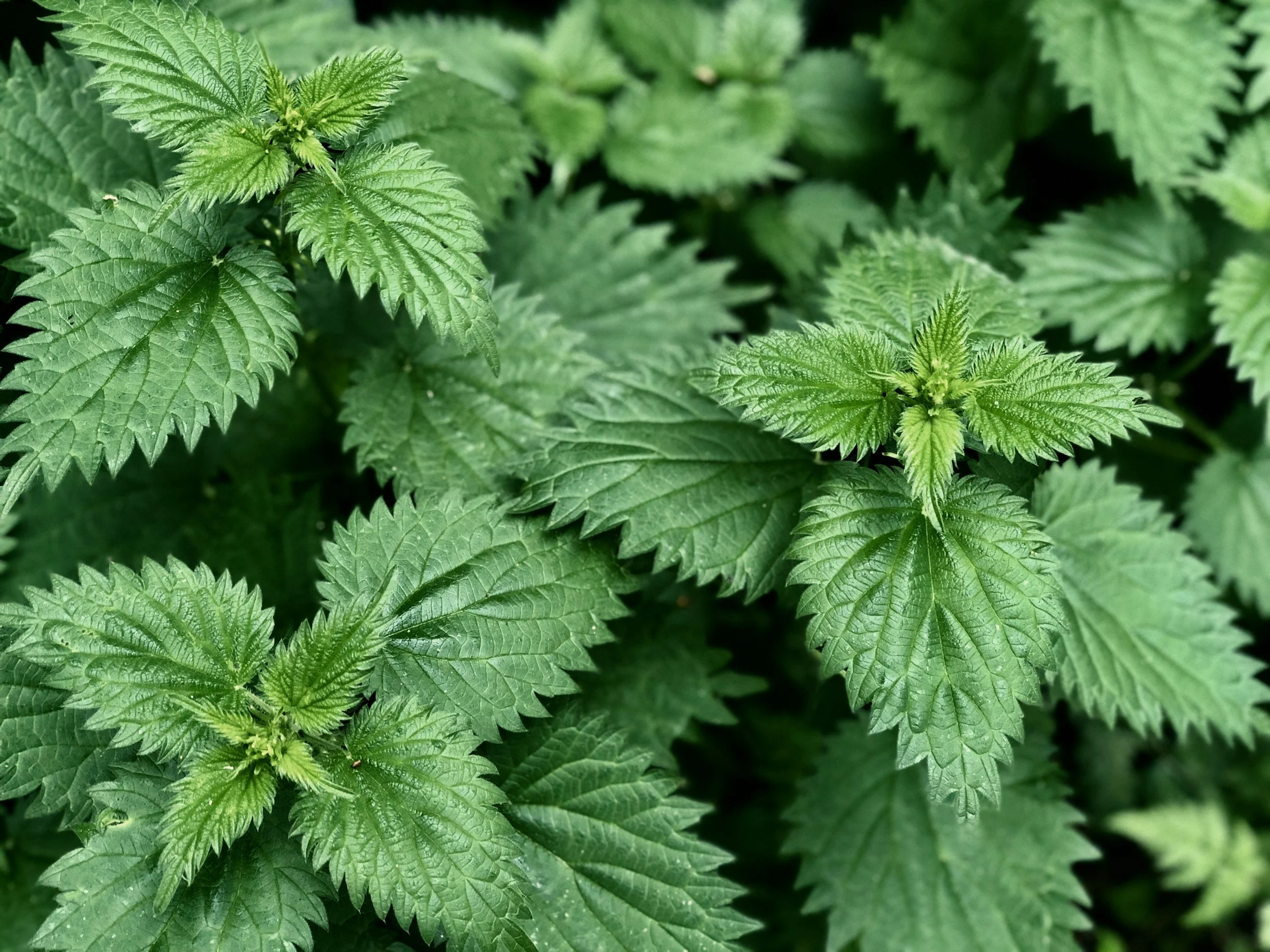
Keep your eyes peeled for the young nettle shoots that are sprouting up along our hedgerows, behind ditches, in the garden — just about everywhere right about now. Most of us spend this time of year trying to avoid them. We step around them, pull them out, warn children about them — and fair enough, they do sting. But for generations before us, nettles were not a nuisance. They were food, medicine, and a welcome sign that the season was turning.
From Roman Remedy to Spring Tonic
Stinging nettles (Urtica dioica) are well featured in Irish folk medicine and further afield, for almost as long as they have been around. Apparently, the nettle was first introduced here by Caesar’s soldiers after their march across Britain. Away from the warmer weather of their home in ancient Rome, and after long miles walked in bare legs, they found themselves in need of a bit of warmth and circulation. Their solution? To gather huge bunches of nettles and beat their legs with them. In hindsight, it might have been less painful to ditch the skirts and wear a decent pair of trousers, but we must be thankful to them — they started a trend. Soon after, nettles were being used to treat everything from joint pain and kidney complaints to skin conditions, hair loss and respiratory issues. Not bad for a plant we now treat like the enemy.
Today, science can explain some of the reasoning behind nettles’ long-standing reputation. The young shoots are a rich source of vitamins and minerals, including vitamins C, E and K, beta-carotene, iron, magnesium, calcium and silica. They have a stimulating action on the kidneys, bladder and urinary system and have traditionally been used as a spring tonic to help the body clear what it no longer needs after the heavier months of winter. Their anti-inflammatory compounds, along with minerals such as silica and boron, have been shown to support joint health and ease conditions such as arthritis and gout.
Stinging nettles also contain natural antihistamines, including quercetin, which can help to dilate constricted bronchial and nasal passages. There is good evidence to support their use in alleviating hay fever and seasonal allergies — once, of course, you are not allergic to nettles themselves. They have also been used to support healthy blood pressure, strengthen blood vessels and, thanks to their iron content, to help in cases of anaemia and fatigue. It is quite a list of benefits from something most of us try not to touch.
Food as Information
But perhaps the more interesting question is not what nettles can do for us, but when and why did we decide they were something to avoid. These plants appear year after year, right on time, offering exactly the kind of nourishment that suits the season — fresh, green, mineral-rich and gently stimulating. They are not just a collection of nutrients on a label. They are, in many ways, information. Every plant carries its own set of compounds and these act as signals that both the body and the gut microbiome can recognise and respond to, guiding functions like digestion, immunity and repair.
They also play a quiet but important role in the wider ecosystem. Nettles are a cornerstone plant for biodiversity, supporting a wide range of insects, including caterpillars of some of our native butterflies. In the garden, their presence is often a sign of fertile, living soil. In their own way, they foster diversity — not unlike the kind we aim for in the gut. A varied, resilient system, strengthened not by restriction, but by exposure to a wide range of inputs.
Interestingly, not all nettles sting with the same intensity. Those growing in shaded areas often have a milder sting than their sun-exposed counterparts. This is thought to be part of the plant’s natural defence strategy — in harsher, more exposed conditions, the plant produces more of the compounds that cause irritation, protecting itself from being eaten. In softer, shaded environments, that defence can afford to be less aggressive. A small but fascinating example of how plants adapt intelligently to their surroundings.
Somewhere along the way, we have lost a little of that connection. We have become very good at looking outside ourselves for guidance — recipes, plans, instructions — while something quietly nourishing grows at our feet. The body, however, has not forgotten. It still knows what to do with a handful of greens, how to respond to bitter flavours, how to make use of what is seasonal and available. Often, it is simply a matter of remembering to pay a little more attention.
Gathering and Using Nettles
The best time to harvest young nettle shoots is from when they first appear until they begin to flower. The young tops are perfect right now. Gloves are advisable, unless you are particularly keen to test the Roman method. Once picked, nettles can be used in a variety of simple ways. A nettle tea is one of the most traditional preparations — simply steep the fresh or dried leaves in hot water. The steam itself can be soothing for the respiratory system and skin, and once cooled slightly, the tea can be enjoyed as a gentle tonic. The soaked leaves can also be used as a compress for sore or inflamed joints. Nothing wasted.
In the kitchen, nettles are surprisingly versatile. A quick blanch or a pour of boiling water will remove the sting, leaving behind a deep green, earthy leaf not unlike spinach. They can be added to soups, stirred through mashed potatoes or eggs, or blended into a pesto with garlic, olive oil and a squeeze of lemon. With the rising cost of food, it is worth remembering that nettles cost nothing at all — just a little time and a bit of care when picking.
So if you find yourself stepping around a patch of nettles this week, you might pause for a moment. Not necessarily to start whipping your legs like a Roman soldier — I wouldn’t recommend it — but perhaps to see them differently. Not as something to avoid, but as something that has been quietly offering nourishment all along.